Tuesday, February 19, 2013

Home Energy


This is an excerpt from one of my labs that I thought would be very interesting to read. I realized by doing this lab that I would be able to participate in more innovative energy ideas.

Home Energy Use Lab

 Today in American culture views consumption as a good thing. The more a person consumes the more successful they must be. However consumption leads to environmental degradation. For example, the purchase of a large house when there is no real need for the extra space leads to negative environmental effects. Larger homes will generally consume more energy to heat and cool causing  more air pollution. Larger homes cover more of Florida's surface, which results in diminished groundwater recharge. In many cases the homeowner may utilize more chemicals on the lawn resulting in more water contamination and the environment suffers. Our home has a large potential for causing environmental degradation so it is worthwhile to do all we can to increase the efficiently of our houses. In this lab you will look at your home and energy use.
 

1.     How large is your home? ___1200___ square feet of living area.                                                              
2.     How large is your lot? ___We live in a town home._____________                                                                         
3.     Does you home have single or double pained windows? _____We have simple single pained windows___                                           
4.     How much insulation do you have in the attic? _We have about 6 inches of insulation_inches (Only gather the data for this section if your attic is easy to access.)
5.     If you run the air conditioner during the summer at what temperature is it set at? __78__ How many hours a day does the AC run ___5___(Estimated)               
6.     Does your home receive any shade? _Yes__  If so, what side(s) of the house are shaded? ___While the sun is setting usually the east side of the house is shaded_________.
7.     How many Killowatts of electricity do you use in the average month? __Our home uses about 870 KWH in an average month.___                                                                                                                                  
8.     If for each 1000-kilowatt hours of electricity produced, 1,250 pounds of air pollution is released into the environment. Determine the number of pounds of air pollution that is produced to provide electricity for your home during the average month. ____1000____ lbs
9.     How much air pollution would be produced by your home electricity production on an annual basis?_____13200_____lbs_
10.   If for each 1000-kilowatt hours of electricity produced, 690 pounds of water pollution is produced. Determine the number of pounds of water your home will produce per month making electricity for your home. _600____lbs.
11.   How much water pollution would be produced per year by providing electricity for your home? ___7200____lbs

Monday, February 18, 2013

Social Media with Environmental Programs


Knowing that we are now a very social generation and are constantly involved with social media, now more than ever before we are able to stay update on everyday literally every second of the day. Since we are involved with things that matter to us, knowing that we can stay up to date on environmental programs is also very useful ! 


Source: http://content.govdelivery.com/bulletins/gd/FLDEP-6c8ce6

CONTACT: DEP Press Office, 850.245.2112, DEPNews@dep.state.fl.us

       DEP LAUNCHES NEW SOCIAL MEDIA ACCOUNTS

~New accounts provide timely information about Florida’s Coral and Aquatic Preserve programs ~

TALLAHASSEE – The Florida Department of Environmental Protection has launched six new social media accounts as part of an ongoing effort to keep Floridians and online users better informed of research, events and news related to the Office of Coastal and Aquatic Managed Areas. Social media users can now find the latest news on Florida’s 4.5 million acres of managed coastlines and aquatic preserves through Twitter and Facebook.
"Our aquatic preserves protect Florida's natural resources on millions of acres throughout the state,” said CAMA Director Kevin Claridge. “Using social media toshowcase these places and what is found within them is a great way to keep Floridians and people worldwide updated on exciting activities and how to access our natural resources appropriately.”
By implementing these new accounts, the Department is working to improve public interaction and increase educational outreach among Floridians by keeping in tune with the ever-growing social media trend.
The Department encourages Floridians and interested users worldwide to follow the accounts below for news related to the Department and Florida's environment:
Aquatic Florida on Twitter: https://twitter.com/Aquatic_FL
For information on the Office’s wide-ranging programs and daily activities, Twitter users can follow @AQUATIC_FL. This account provides followers with information on statewide and local information and activities. From environmental news to events and news from the field, this Twitter account will keep users informed of day-to-day activities. Each week will focus on a different site with a daily tweet with news and information of that location.
Big Bend Seagrasses Aquatic Preserve on Facebook:https://www.facebook.com/BigBendSeagrassesAquaticPreserve
Spanning over 984,000 acres, the Big Bend Seagrasses Aquatic Preserve is the largest aquatic preserve and one of the most pristine places in Florida. It encompasses the second largest continuous area of seagrass in the Gulf of Mexico, for which it is world renown. ‘Like’ this page and learn all about the importance of seagrass for your Florida life style.
The Indian River Lagoon Aquatic Preserves on Facebook:https://www.facebook.com/IndianRiverLagoonAP
The Indian River Lagoon Aquatic Preserves Field Office manages seven Aquatic Preserves, over 95,000 acres, of the Indian River Lagoon from Volusia to Palm Beach County.The Lagoon is one of the most biologically diverse places in the nation. ‘Like’ this page to learn something new about Florida’s environment.
Biscayne Bay Aquatic Preserves on Facebook:https://www.facebook.com/BiscayneBayAquaticPreserves
The Biscayne Bay Aquatic Preserves oversees 67,000 acres of submerged lands that include seagrass beds, mangroves, hardbottom communities and sand flats. ‘Like’ this page to find activities on and around the Bay.
Estero Bay Aquatic Preserves on Facebook:https://www.facebook.com/EsteroBayAquaticPreserve
Estero Bay was designated as Florida's first aquatic preserve in 1966. Aquatic preserve staff work to preserve the bay in its essentially natural condition, so that the aesthetic, biological and scientific values endure for the enjoyment of future generations. ‘Like’ this page and see how history has kept a gem of Florida shining today. 
Florida’s Coral Program on Facebook:https://www.facebook.com/FloridasCoralProgram
The Coral Reef Conservation Program's vision is that the health and management of Florida’s coral reefs and associated reef resources are improving and global coral reef conservation goals are being met effectively to ensure sustainable marine resources and a high quality of life for the State of Florida, its citizens and visitors, today and in the future.  ‘Like’ this page to see astounding coral pictures.
Aquatic Florida on Pinterest: http://pinterest.com/aquaticflorida/
This page, launched last year, shares photos of aquatic preserve activities, neat critters seen, available activities on state-owned and managed properties and the work that Department staff is doing to protect the environment. Come check out the beauty of Florida through photos shared through this account.
These new accounts will join the other existing social media accounts that the Department actively updates. Together, these accounts reach more than 50,000 users.

Thursday, February 14, 2013

Protection for the Springs!


This Press Release today was a good read, knowing that I live just 20 minutes away from the Rainbow Springs and it is a beautiful area that my family and I use as a place to go with friends and family, it's important to give back. In this article I read how the FDEP has now recognized that the Nitrate levels in the Rainbow River and also Jackson Blue Springs are way too high and will be brought down. 

DEP REACHES NEW MILESTONE IN SPRINGS PROTECTION

~Restoration goals now set for hundreds of Florida springs~

TALLAHASSEE - The Florida Department of Environmental Protection has adopted restoration goals for the Rainbow Springs Group and Rainbow River in Marion County, and Jackson Blue Spring and Merritts Mill Pond in Jackson County. These restoration goals, or Total Maximum Daily Loads, are scientifically derived pollution reduction targets designed to drive nitrate reductions so that the spring systems meet water quality standards and support healthy biological communities.
Including Rainbow and Jackson Blue springs, the Department has now identified the specific pollution problems to be tackled and established four pollution reduction goals affecting approximately 250 springs. Another five goals are scheduled for adoption this year to help restore 65 additional springs.
“The Department has made springs restoration a statewide priority and are working hard to address nutrient impacts to these unique waterbodies,” said DEP Secretary Herschel T. Vinyard, Jr. “We have seen a continued increase in nutrients in Florida’s springs since the 1960s and we are taking action to reverse this trend.”
The goal setting is just the first step for Rainbow Springs and Jackson Blue Spring.  The Department will now forge restoration plans in concert with local stakeholders before the end of the year. These restoration plans will identify the projects necessary to reduce the sources of pollution, the resources necessary to implement them and the schedules for carrying them out.     
“Nitrate loadings must be cut by 82 percent for Rainbow Springs and 90 percent for Jackson Blue,” said Drew Bartlett, Director of DEP’s Division of Environmental Assessment and Restoration. “The problems are complicated. They weren’t created overnight and they won’t be solved tomorrow, but together we will restore these springs.”
Elimination of excess algae and invasive plants and better management of wastewater, stormwater and agricultural sources will be essential to achieving restoration. Basin residents making simple changes in their everyday life to conserve water, limit lawn fertilizing, properly maintain their septic tanks and pick up after their pets will also have a meaningful impact.
Last year, the Department adopted its first springs restoration plan carving out the path to restoration for the spring-fed Santa Fe and Ichetucknee Rivers, with another four restoration plans to benefit springs slated in 2013 for the Suwannee River Basin and its springs, Wakulla Springs, Silver Springs and the Wekiva River and its springs.  
With the support of Governor Rick Scott and the Florida Legislature, the Department has committed $11.5 million to springs restoration, outreach, monitoring and research over the past two years. This is double the amount of money dedicated to springs during the three previous fiscal years. In addition, Governor Scott’s Florida Families First FY2013/2014 budget calls for an additional $6.5 million in direct funding for springs restoration and protection.
For more information about the Department’s TMDL and BMAP programs, visit:http://www.dep.state.fl.us/water/tmdl/index.htm

Monday, February 11, 2013

Forbes: 10 Innovation European Energy Ideas?

Browsing on Forbes I was happily surprised to find an article about innovative energy. Not too long ago I have no idea what "innovative energy" meant or what it consisted of. In my own personal simple terms innovative energy is new ways to reuse and source our energy that doesn't hurt our natural resources at such a great scale.

Source: http://www.forbes.com/2008/06/18/european-energy-innovations-tech-innovationeu08-cx_vr_0618energy_slide_2.html?thisspeed=25000

The article is titled: In Pictures: 10 Innovative European Energy Ideas

Here are some of the interesting pictures I found: 

This one I feel would be a very interesting project and would be so interested to one day see one floating in person from an aerial view. My only concern would be to how much damage would be done to the natural wildlife in the ocean where it will be floating.
This one caught my eye right away and I couldn't believe how interesting this would be to be part of it. This is a wonderful example of a great innovative energy source just with our own body heat!
My first thought when reading this one was....how interesting! Now there could be actual sea serpents in the water. The thought of boating and possibly seeing this giant machine making a huge wave doesn't sound the safest but I do think it's a great idea to get energy from waves.
This one blew my mind! This true molecular biology and biotechnology. This definitely is a powerful way to regenerate solar energy. 


Overall, I enjoyed reading this article and was able to share it with friends and family as well.


Tuesday, February 5, 2013

2012 World's Green Countries Guessing Game


I got into a discussion with my father who is taking Environmental Lab this Spring Semester with me about how we as a country don't do our best with our environment  I asked him if he knew what country was the "greenest" country in the world and we started simply guessing which ones we thought would be among the top. This was our list:

1) Switzerland
2) France
3) UK
4) Australia
5) Germany

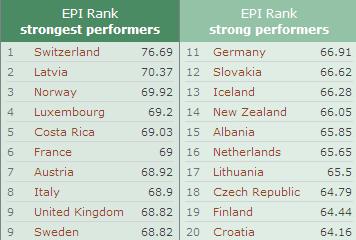
After playing this little guessing game we decided to on ahead and find out what it really was for 2012, and these were the results we from in an online article:

*Not my personal content*

Source: http://www.baltic-course.com/eng/analytics/?doc=52268


"Switzerland is the greenest country worldwide. Latvia is ranked second, ahead of such countries as Norway, France, Great Britain and Sweden, according to "Environmental Performance Index" (EPI) by Yale and Columbia universities.

The executive director of the environmental organization "homo ecos", Sanita Ribena, informed LETA that Latvia is second among 132 countries.

Lithuania is ranked 17th, but Estonia – 54th.


Source: http://epi.yale.edu

EPI is a quantitative study. It follows the state of national environments and uses the best available data. The research has been out for a while, and its findings are published once per two years. In 2008, Latvia was ranked eighth, whilst in 2010 – 21st.

Latvia's society became familiar with EPI two years ago due to "homo ecos" campaign – "Latvia – the greenest country in the world?" – when the organization urged people to replace their habits with more environmentally friendly ones.

"Latvia's richness lies in its resources – biological diversity, water and air. We are living in royal conditions, compared to other places worldwide. Unfortunately, these resources are not everlasting. They are too valuable to estimate their value in any currency, however, they are our country's added value. It is important to remember this when planning Latvia's economic development," emphasized Ribena.

This year, the traditional EPI is also accompanied by "Pilot Trend Environmental Performance Index". This research reveals how various countries gradually solved their environmental issues from 2000 to 2010. In this study, Latvia is ranked first."

Thursday, January 31, 2013

$1.2 Billions dollars to the State?!

I easily signed up to receive email Press Release's for the State of Florida and this one came in just yesterday and found it to be a positive one. 

$1.2 billion dollars sounds like a lot of money to deal with so it was good to see what the budget was going to be with this money and where it would be distributed. 

Biggest budget plan will go towards restoring waterways and water supply at 269.5 million, and the smallest budget here will go towards State Park Improvements  I think Governor Rick Scott made a good outline on what would be best for the State knowing that at this point ensuring our waterways and water supply are at it's best.


*Not my personal material*


GOVERNOR SCOTT'S BUDGET RECOMMENDS $1.2 BILLION TO PROTECT AND RESTORE FLORIDA'S ENVIRONMENT

~Funding for Everglades, springs and land conservation~

TALLAHASSEE – Today, Florida Department of Environmental Protection Secretary Herschel T. Vinyard, Jr. applauds Governor Rick Scott’s environmental priorities within his Florida Families First FY2013/2014 budget. The $1.2 billion budget will include support for restoration projects in the Everglades, springs water quality improvements and the purchase of conservation land. The budget places a priority on projects that protect and renew our waterbodies in line with the Department’s emphasis on getting the water right.
“By requesting more than a billion dollars to continue our pursuit of robust environmental protection, Governor Scott clearly understands that the future of Florida depends on its natural resources,” said Secretary Vinyard. “This funding will restore water quality in the Everglades, rejuvenate our springs and provide a clean environment for all Floridians.”
Proposed budget items include:
$60 million to fund the Governor’s Everglades Water Quality Plan and continuing funding for the Comprehensive Everglades Restoration Plan.Governor Scott has doubled the amount of money spent on Everglades Restoration in FY2012/2013. Scott’s leadership turned this historic undertaking into a reality. The plan builds upon a $1.8 billion investment in Everglades water quality improvements. The budget includes design, engineering and construction of flood control projects to enhance water quality and ensure a reliable water supply for southern Floridians and the numerous species that thrive in the area.         
$269.5 million for restoring waterways and water supply. This will ensure the future supply by improving on the water quality regulations for springs, lakes, rivers and estuaries. The FY2013/2014 budget commits an increase of $6.5 million for springs restoration. Additionally, the budget will support the practical application of the water quality criteria by endorsing wastewater treatment facility construction, drinking water facility construction, and water quality planning. Under Governor Scott’s leadership, the department doubled the amount of money spent in the previous three fiscal years on the state’s springs and developed more water quality criteria last year than in any year in the last decade.
$75 million for Florida Forever. The budget recommends $50 million in budget authority from the proceeds of the sale of surplus state lands. Governor Scott identified an additional $25 million from General Revenue for the purchase of conservation lands needed for springs protection, military buffering or water resource protection. This investment helps ensure Floridians can enjoy our natural treasures.
$25 million for beach erosion control. This new commitment will help restore and maintain Florida’s sandy beaches that provide a warm welcome to millions of visitors each year. The local governments responsible for the state’s most valuable and recognizable natural resource will benefit from state assistance for beach and dune restoration, beach nourishment, inlet sand bypassing and regional sediment management.
$19 million for state park improvements. This money will provide an opportunity to enhance the amenities throughout Florida’s vast state park system. Governor Scott proposed an increase of $6 million to the FY2012/2013 budget to continue Florida’s tradition of the nation’s best park systems.
For additional details on the Governor’s recommended Florida Families First FY2013/2014 budget, visit www.floridafamiliesfirst.com.

Wednesday, January 23, 2013

Silver Springs Attraction Made Into State Park


This past month in January I was able to visit the Silver Springs Attraction with a couple friends that were visit from out of the country. They were amazed at the natural beauty that was found just 20 minutes from my home. For them is was nice coming from a big and very busy city to a nice park that just showed off the areas natural beauty. We were able to even ride the famous glass bottom boat. 


I find that having park like this connected to the Silver River State Park is phenomenal in the sense that it is a natural preserved place. This article that was realized this past week was a great read in knowing that now the Silver Spring Attraction has become park of the Florida State Parks, which allows the FPEP to step and take action in keeping our spring and river waters clean!

*Not my personal material*

[Obtained from website: http://content.govdelivery.com/bulletins/gd/FLDEP-686207]

Making Silver Springs Attraction a state park allows the Florida Department of Environmental Protection to continue its water quality work in the springs basin.


"TALLAHASSEE – The Florida Cabinet, sitting as the Board of Trustees of the Internal Improvement Trust Fund, today approved the modification of a lease agreement between Palace Entertainment and the state of Florida, allowing the property to become part of Florida's state park system on Oct. 1.
Palace Entertainment's lease to manage the Silver Springs Attraction ran until Dec. 31, 2029. Through negotiations with the Florida Department of Environmental Protection, the state has secured $4 million in work by Palace Entertainment in order to restore the property to its natural condition, as originally intended by the Board of Trustees. Palace Entertainment will continue to manage the property until Sept. 30 and during that time the Silver Springs Attraction will be open.
"We are pleased that the Governor and Cabinet have decided to approve this agreement so that the Department can return the property closer to its natural state, involve the community in recreation opportunity decisions and continue our efforts of improving water quality in Silver Springs, one of Florida's most iconic treasures," said DEP Secretary Herschel T. Vinyard, Jr.
The Department will begin implementing the Interim Facilities and Operations Planthat was presented to the public Jan. 14 by the Florida Park Service. The long term unit management plan, which is required by Florida Statutes, is anticipated to be completed by September 2014.
“Florida’s 171 state parks, trails and historic sites are pleased to welcome the Silver Springs property into our family of resource-based recreation areas and historic and cultural sites,” said Donald Forgione, DEP’s Florida Park Service Director. “We look forward to working with Palace Entertainment during the transition and to opening the gates on Oct. 1 as a state park.”
Turning the property into a state park is another step the Department has taken to restore Silver Springs. Also Wednesday, the Department's Division of Environmental Assessment and Restoration held the first meeting to finalize a basin management action plan for Silver Springs -- the first such restoration plan to reduce nitrates affecting the springs. Department research and monitoring led to designating Silver Springs and the Upper Silver River as impaired for nitrate, a form of nitrogen that causes excessive algae growth in the spring system. 
Last November, the Department finalized the total maximum daily load or, in this case, the maximum acceptable concentration of nitrate, at 0.35 milligrams per liter. This is the same restoration target that the U.S. Environmental Protection Agency has adopted for springs — based on the Department’s data — and that has been upheld in both state and federal courts. Meeting the restoration target will protect aquatic life and bring the system back into balance.
The Florida Department of Environmental Protection expanded its efforts to restore Silver Springs last July, committing more than $1 million to water quality improvement projects.
The Department, Marion County and the St. Johns River Water Management Districthave identified the first project to benefit from this funding, committing $300,000, $300,000 and $100,000, respectively, toward the project. The project will eliminate a wastewater discharge from the Silver Springs Regional Wastewater Treatment Plant, which is within 1.5 miles of the main boil of Silver Springs. It will redirect wastewater to the Silver Springs Shores Wastewater Treatment Plant, which provides higher level treatment and is 10 miles from the head spring. 
In a subsequent phase of the project, a series of small “package” wastewater treatment plants also will be connected to the central facility, which will provide better treatment and reduce pollution. Implementation of these actions collectively will eliminate more than two tons of nitrogen currently going into the Silver Springs system every year."